RBI Floating Rate Savings Bonds 2020 (Taxable), 2026 guide: 8.05% interest, 7-year lock-in, early exit for seniors, tax and how to buy
RBI Floating Rate Savings Bonds, 2020 (Taxable) pay 8.05% a year for July–December 2026 (NSC rate 7.70% + 0.35%). The rate is reset every six months, and interest is paid every 1 January and 1 July — there is no cumulative option. The bonds run for 7 years, have no maximum limit, and are only for resident individuals and HUFs (not NRIs). Early encashment is allowed only for individuals aged 60+, after a lock-in of 6 years (age 60–70), 5 years (70–80) or 4 years (80+), with a penalty of half of the last six months' interest. Interest is fully taxable and TDS applies. Buy at designated bank branches (SBI, nationalised banks, some private banks) or online through them.
Key facts Last verified: 29 Oct 2026
| Item | Details | Source |
|---|---|---|
| Rate | 8.05% (7.70% NSC + 0.35%) for 1 Jul–31 Dec 2026, payable on 1 Jan 2027 | RBI press release, 1 Jul 2026 |
| Who can invest | Resident individuals (incl. joint) and HUFs; NRIs not eligible; no maximum limit | RBI press release, 26 Jun 2020 |
| Tenor and interest | 7 years; interest every 1 Jan and 1 Jul; no cumulative option; not tradable or usable as loan collateral | RBI press release, 26 Jun 2020 |
| Premature encashment | Lock-in 6 years (60–70), 5 years (70–80), 4 years (80+); penalty 50% of last six months' interest | RBI — FRSB 2020 (T) operational guidelines |
| Operational guidelines | Revised 2 Apr 2026: Bond Ledger Account, cash up to ₹20,000, TDS on interest, PAN needed | RBI notification RBI/2026-27/06 |
Shobha, a retired teacher in Kolhapur, is 66. She has already filled her Senior Citizen Savings Scheme account up to the ₹30 lakh limit, and her son suggested "RBI bonds" for another ₹10 lakh because there is no upper limit and the rate is 8.05%. Is that a good idea, and can she get her money back early if she needs it?
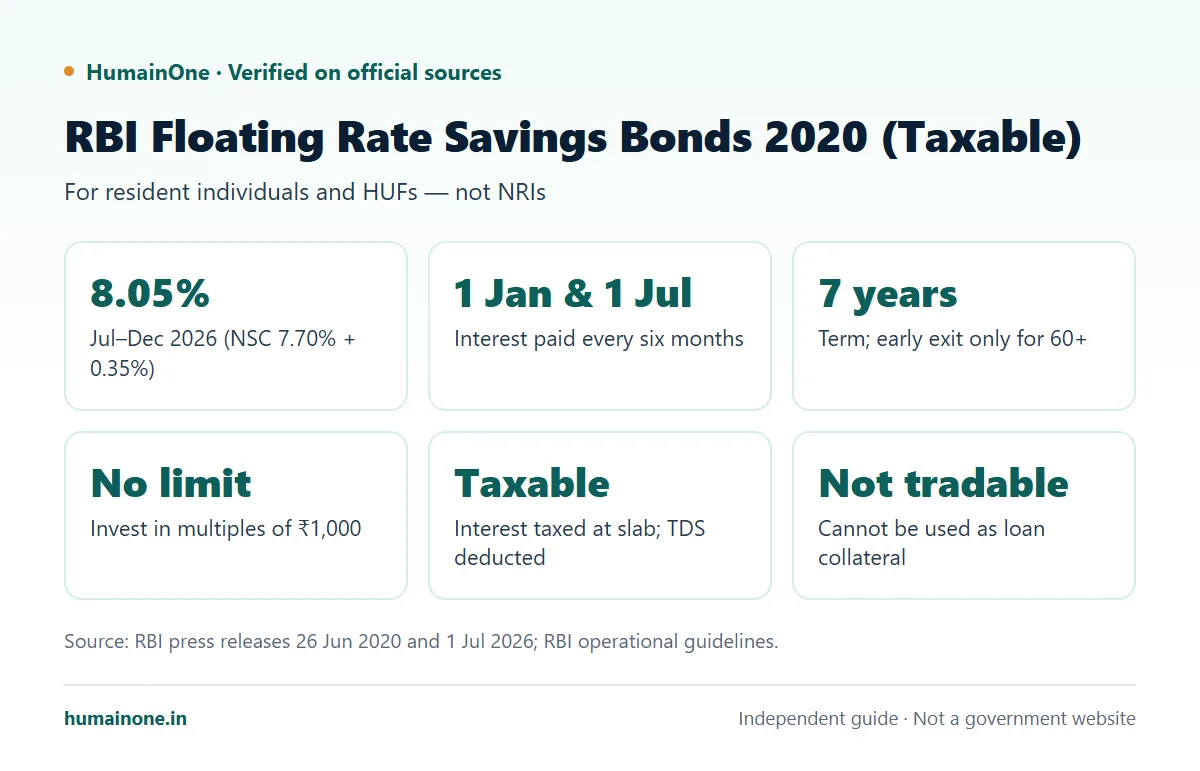
Key features
| Feature | Rule |
|---|---|
| Interest rate | NSC rate + 0.35%, reset every 6 months. 8.05% for 1 Jul–31 Dec 2026 |
| Interest paid | Every 1 January and 1 July, straight to your bank account. No cumulative option |
| Term | 7 years from the date of issue |
| Amount | In multiples of ₹1,000; no maximum |
| Who can buy | Resident individuals (single or joint) and HUFs. NRIs cannot |
| Form | Electronic, held in a Bond Ledger Account; you get a Certificate of Holding |
| Transfer / trading | Not tradable, cannot be used as loan collateral |
| Tax | Interest is taxable at your slab rate; TDS is deducted. No tax deduction for investing |
Floating means the rate can go up or down every January and July, depending on the NSC rate. In return, it is always 0.35% above NSC.
Can you withdraw early?
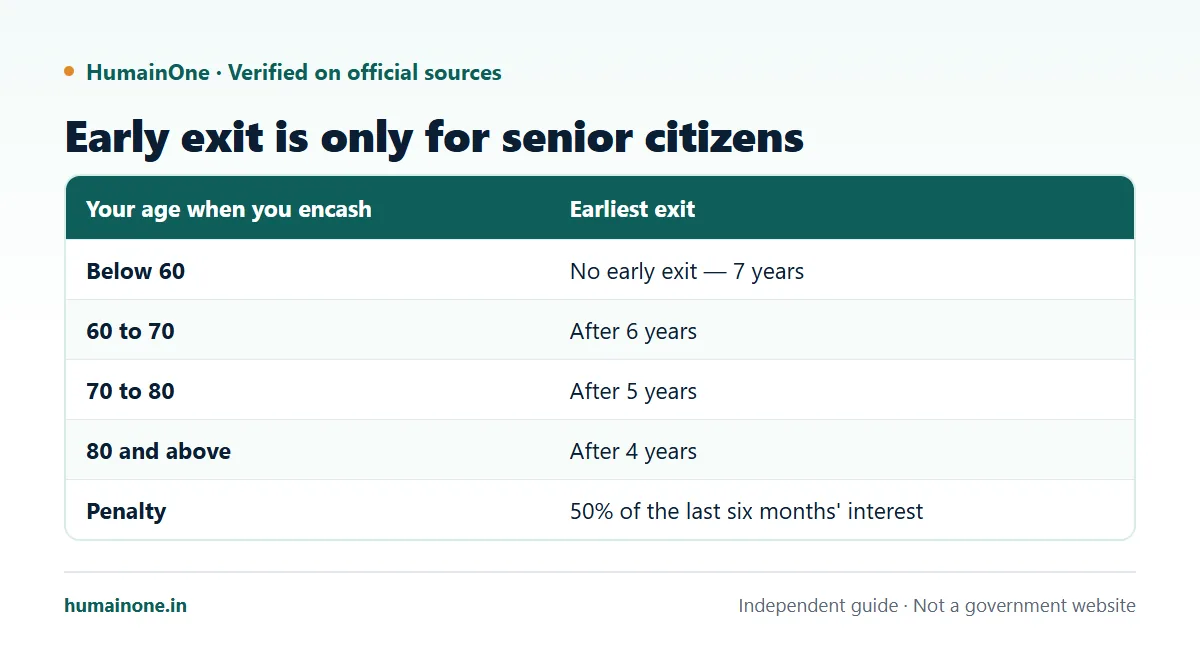
| Your age on the day you encash | Earliest exit after |
|---|---|
| Below 60 | No early exit — wait the full 7 years |
| 60 to 70 | 6 years |
| 70 to 80 | 5 years |
| 80 and above | 4 years |
- Penalty: 50% of the interest for the last six months of holding is recovered.
- No partial encashment of a single application — so buy in 2–3 separate applications if you may need part of the money early.
- For joint holdings, at least one holder must meet the age rule.
For Shobha (66), money put in now can come out early only after 6 years — so this suits money she won't need soon.
How it compares (Oct–Dec 2026 rates)
| Option | Rate | Limit | Early exit | Tax |
|---|---|---|---|---|
| RBI Floating Rate Bond | 8.05% (changes every 6 months) | No limit | Only 60+, after 4–6 years | Interest taxable |
| Senior Citizen Savings Scheme | 8.2% | ₹30 lakh | Yes, with deduction | Interest taxable |
| Post Office MIS | 7.4% | ₹9 lakh / ₹15 lakh joint | After 1 year, with deduction | Interest taxable |
See Senior Citizen Savings Scheme, Post Office MIS and all small savings rates. Seniors: check how the interest affects your tax in income tax for senior citizens.
How to buy
- Visit a designated branch of SBI, a nationalised bank, IDBI Bank, or the private banks authorised by RBI (such as Axis, HDFC and ICICI), or use the bank's online option where offered.
- Fill the application (Form B) with your PAN, bank account for interest, and nominee.
- Pay by cheque, draft or online (cash only up to ₹20,000).
- The bonds go into your Bond Ledger Account; you receive a Certificate of Holding.
- Interest is credited every 1 January and 1 July. If your income is below the taxable limit, give the bank the no-TDS declaration — see Form 121 (old 15G/15H).
Frequently asked questions
What is the RBI Floating Rate Savings Bond interest rate now?
8.05% a year for 1 July to 31 December 2026 (NSC rate 7.70% + 0.35%), payable on 1 January 2027. The rate is reset every six months.
Can NRIs invest in RBI Floating Rate Savings Bonds?
No. Only resident individuals, including joint holders, and Hindu Undivided Families can invest.
Can I withdraw RBI bonds before 7 years?
Only individuals aged 60 or more can, after 6 years (age 60–70), 5 years (70–80) or 4 years (80+). Half of the last six months' interest is deducted as penalty.
Is the interest on RBI bonds tax-free?
No. Interest is taxable as per your slab and TDS is deducted. There is no tax deduction for the investment.
Is there a maximum limit on RBI Floating Rate Savings Bonds?
No. There is no upper limit; investment is in multiples of ₹1,000.
How often is interest paid on RBI bonds?
Twice a year, on 1 January and 1 July. There is no cumulative option.
Official links
Use only these government websites. HumainOne is not connected to any of them.
- RBI — Rate for 1 Jul–31 Dec 2026 (press release, 1 Jul 2026)8.05%
- RBI — Floating Rate Savings Bonds, 2020 (Taxable) (26 Jun 2020)Eligibility, tenor, interest dates
- RBI — FRSB 2020 (T) operational guidelines (revised 2 Apr 2026)Bond Ledger Account, TDS, nomination
- RBI — FRSB 2020 (T) operational guidelines (2020, updated 2022)Premature encashment lock-in and penalty
Disclaimer: HumainOne is an independent information website. We are not affiliated with UIDAI, the Income Tax Department, EPFO, NPCI, the Election Commission, the Government of Maharashtra or any government body. We do not accept applications, documents or fees. Information is checked against official sources on the date shown but rules change — always confirm on the official website before acting. Calculators give estimates, not official figures, and this is not tax or legal advice.