TDS on rent in 2026-27: when a tenant must deduct 2%, when businesses deduct 10%, the ₹50,000-a-month limit, and what landlords should check
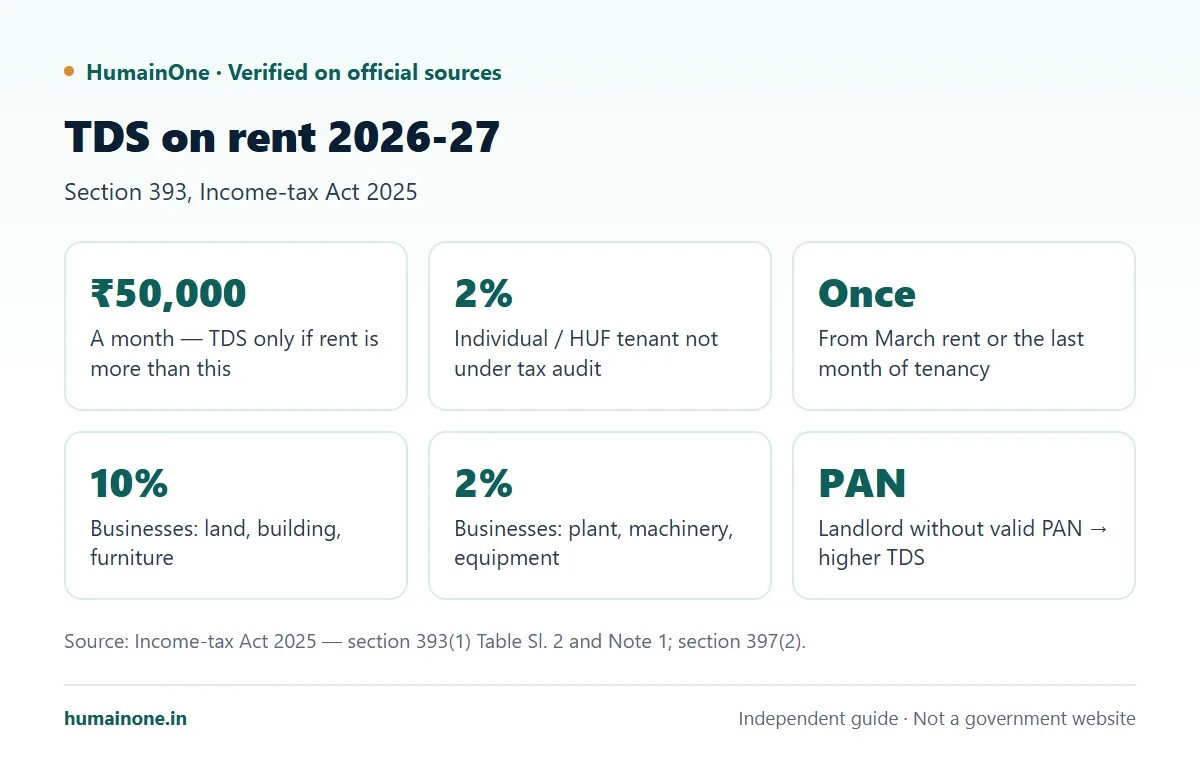
Under section 393 of the Income-tax Act, 2025, an individual or HUF tenant (salaried people, or anyone not liable to tax audit) must deduct 2% TDS if the rent is more than ₹50,000 for a month or part of a month — and deducts it once, from the rent of the last month of the tax year (March) or the last month of tenancy, whichever is earlier. Businesses and others who must deduct TDS (the "specified persons", e.g. companies, firms, audited businesses) deduct 10% on rent for land, buildings, furniture or fittings and 2% on machinery or equipment, also when rent exceeds ₹50,000 a month. Rent of ₹50,000 or less a month needs no TDS. If the landlord has no PAN or an inoperative PAN, TDS is higher.
Key facts Last verified: 29 Oct 2026
| Item | Details | Source |
|---|---|---|
| Individual / HUF tenant | Rent: 2%, threshold ₹50,000 for a month or part of a month | Income-tax Act, 2025 — section 393(1), Table Sl. 2(i) |
| When | Deducted at credit or payment, whichever is earlier, for the last month of the tax year or the last month of tenancy | Income-tax Act, 2025 — section 393, Note 1 |
| Specified persons | Rent: 2% machinery/plant/equipment; 10% land, building, furniture, fittings; threshold ₹50,000 a month | Income-tax Act, 2025 — section 393(1), Table Sl. 2(ii) |
| TDS rates chart | Rent by individual or HUF not liable to tax audit: 2% | Income Tax Department — TDS rates |
| No / inoperative PAN | Higher TDS rate for payees without a valid PAN | Income-tax Act, 2025 — section 397(2) |
Ankit, an IT engineer, moved into a 3BHK flat in Baner, Pune in April 2026 at ₹55,000 a month. His friend Neha pays ₹48,000 a month for a flat in Thane. Ankit's landlord has asked him about "TDS on rent" and Ankit has no idea whether he has to deduct anything, how much, or when. Neha wonders if she has to do the same.
Who deducts how much
| Who pays the rent | Rent is for | TDS rate | Only if rent is |
|---|---|---|---|
| Individual or HUF not liable to tax audit (most salaried tenants) | House, flat, shop — any property | 2% | More than ₹50,000 for a month or part of a month |
| Specified person (companies, firms, businesses/professionals whose accounts are audited, etc.) | Land, building, furniture, fittings | 10% | More than ₹50,000 a month |
| Specified person | Plant, machinery, equipment | 2% | More than ₹50,000 a month |
- Neha (₹48,000 a month): no TDS. Her rent is not more than ₹50,000 in any month.
- Ankit (₹55,000 a month): yes, 2% TDS. He is a salaried individual, so he deducts once a year, not every month.
When and how much — Ankit's example
The law says an individual tenant deducts this TDS from the rent for the last month of the tax year (March) or the last month of the tenancy, whichever is earlier — on the whole rent for the year or tenancy period.
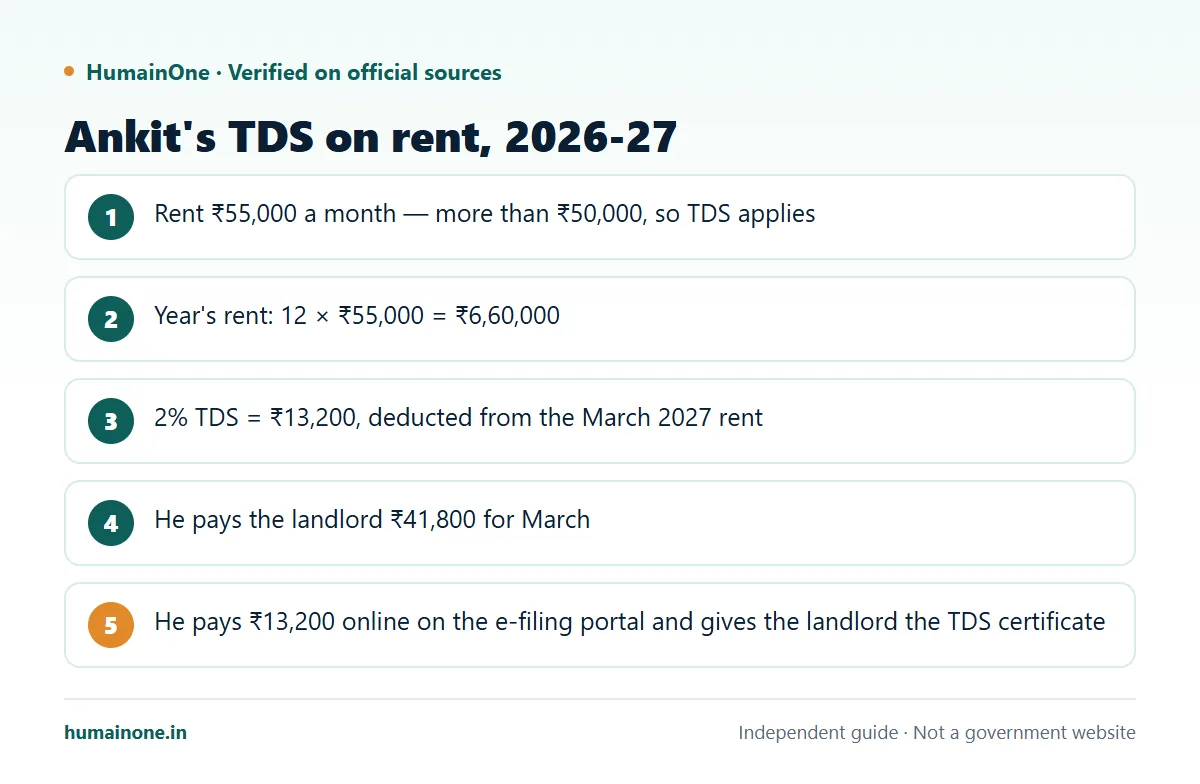
For tax year 2026-27 (April 2026–March 2027), if Ankit stays all year:
- Rent for the year = 12 × ₹55,000 = ₹6,60,000
- TDS @ 2% = ₹13,200, deducted from the March 2027 rent
- Ankit pays the landlord ₹41,800 for March 2027 (₹55,000 − ₹13,200) and deposits ₹13,200 with the government
If he moves out in November 2026, he deducts 2% on the April–November rent (8 × ₹55,000 = ₹4,40,000 → ₹8,800) from the November rent instead.
*These are our calculations from the rate and rule in section 393.*
Steps for the tenant
- Get the landlord's PAN (and check it is operative). Without a valid PAN, the TDS rate is higher.
- Deduct 2% from the rent of the last month (March, or the month you move out).
- Pay the TDS online on the Income-tax e-filing portal (incometax.gov.in → e-Pay Tax), choosing the option for TDS on rent of property, and fill in the tenant, landlord and rent details.
- Download the TDS certificate from the portal after the payment is processed and give it to your landlord.
- Keep the rent agreement, receipts and payment challan with your records.
Late? If you deduct late or deposit late, interest and a late fee apply — do it within the due date shown on the portal. Claiming HRA at work as well? See the HRA exemption calculator.
For landlords
- Check the TDS in your Form 26AS / AIS and claim credit for it in your return. See TDS not showing in 26AS.
- Keep your PAN linked to Aadhaar; an inoperative PAN means tenants must deduct at a higher rate — see PAN inoperative.
- The rent is your income under "house property"; TDS is only an advance part of the tax.
Section numbers changed from 1 April 2026: old 194-IB (individual tenants) and 194-I (businesses) are now entries in section 393. See old vs new section numbers.
Frequently asked questions
What is the TDS on rent limit for 2026-27?
TDS applies only when rent is more than ₹50,000 for a month or part of a month. At ₹50,000 a month or less, no TDS is needed.
Does a salaried tenant have to deduct TDS on rent?
Yes, if the rent is more than ₹50,000 a month. An individual or HUF not liable to tax audit deducts 2%, once, from the rent of March or the last month of tenancy.
What is the TDS rate on rent for companies and businesses?
10% on rent for land, buildings, furniture or fittings and 2% on rent for plant, machinery or equipment, when rent exceeds ₹50,000 a month.
Which section covers TDS on rent under the new Income-tax Act?
Section 393(1) of the Income-tax Act, 2025. It replaced old sections 194-I and 194-IB from 1 April 2026.
What if my landlord does not have a PAN?
TDS must then be deducted at a higher rate under section 397(2). Ask the landlord for a valid, operative PAN.
Official links
Use only these government websites. HumainOne is not connected to any of them.
- Income-tax Act, 2025 — Section 393 (TDS table)Rent rates, threshold, when to deduct
- Income Tax Department — TDS ratesRent rows
- Income-tax e-filing portalPay TDS on rent, download certificate
Disclaimer: HumainOne is an independent information website. We are not affiliated with UIDAI, the Income Tax Department, EPFO, NPCI, the Election Commission, the Government of Maharashtra or any government body. We do not accept applications, documents or fees. Information is checked against official sources on the date shown but rules change — always confirm on the official website before acting. Calculators give estimates, not official figures, and this is not tax or legal advice.