Capital gains tax on selling a flat, house or land in 2026: 12.5% without indexation, the 20% indexation option, CII 384, exemptions and TDS
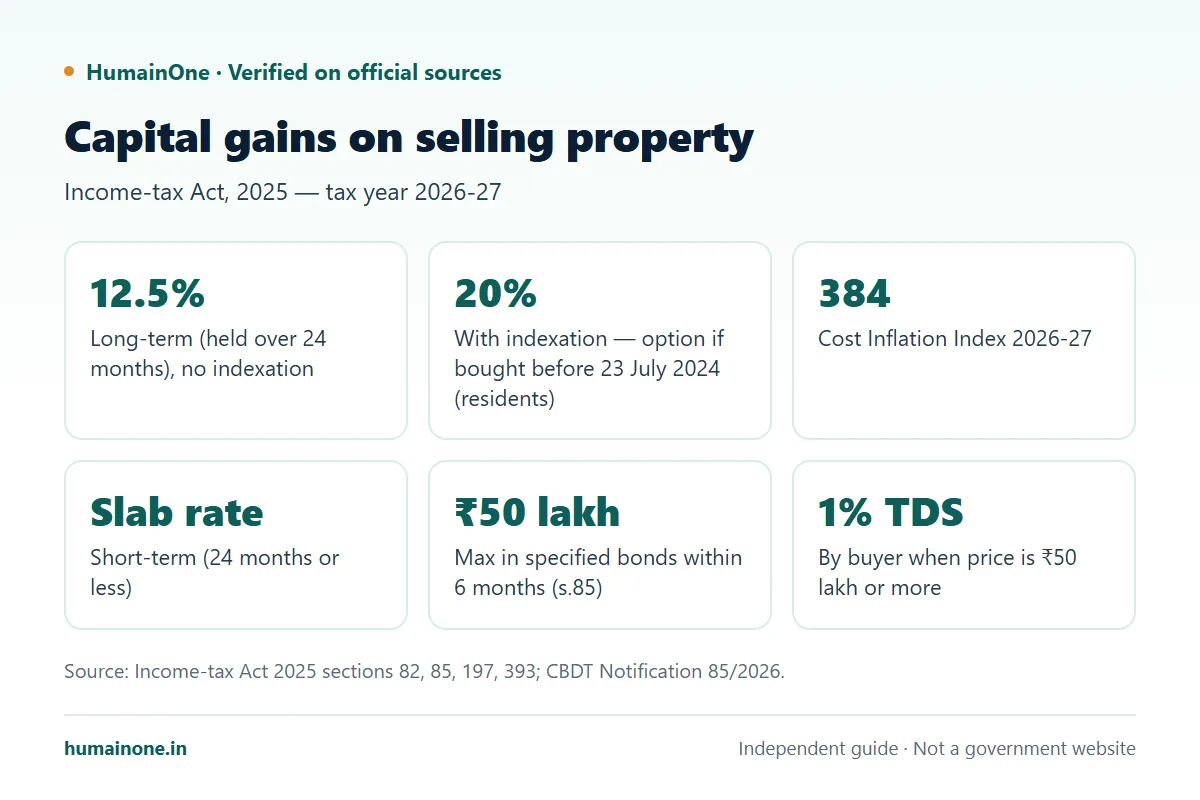
If you sell a flat, house or land held for more than 24 months, the profit is a long-term capital gain (LTCG) taxed at 12.5% without indexation (section 197, Income-tax Act 2025). For resident individuals and HUFs selling land or a building bought before 23 July 2024, the law lets you pay the lower of (a) 12.5% without indexation or (b) 20% with indexation — the Cost Inflation Index for 2026-27 is 384. Held 24 months or less? The gain is short-term and taxed at your slab rate. You can save the tax by buying another house (section 82, old 54), putting up to ₹50 lakh in specified bonds within 6 months (section 85, old 54EC), or, for other assets, investing in a house (section 86, old 54F). The buyer deducts 1% TDS when the price is ₹50 lakh or more.
Key facts Last verified: 29 Oct 2026
| Item | Details | Source |
|---|---|---|
| LTCG rate | 12.5% without indexation for transfers on or after 23 Jul 2024 | Income-tax Act, 2025 — section 197 |
| Indexation option | Resident individual/HUF, land or building acquired before 23 Jul 2024: excess over tax at 20% with indexation is ignored | Income-tax Act, 2025 — section 197(3) |
| CII 2026-27 | 384 (2025-26: 376; 2001-02: 100) | CBDT Notification No. 85/2026, 15 Jul 2026 |
| New house | LTCG on a house reinvested in one house (1 yr before / 2 yrs after, or built in 3 yrs); two houses if gain ≤ ₹2 crore; ₹10 crore cap | Income-tax Act, 2025 — section 82 |
| Bonds | LTCG on land/building invested within 6 months in long-term specified bonds; max ₹50 lakh; 5-year lock-in | Income-tax Act, 2025 — section 85 |
| Buyer's TDS | 1% of price or stamp duty value (higher), threshold ₹50 lakh | Income-tax Act, 2025 — section 393(1) Table 3(i) |
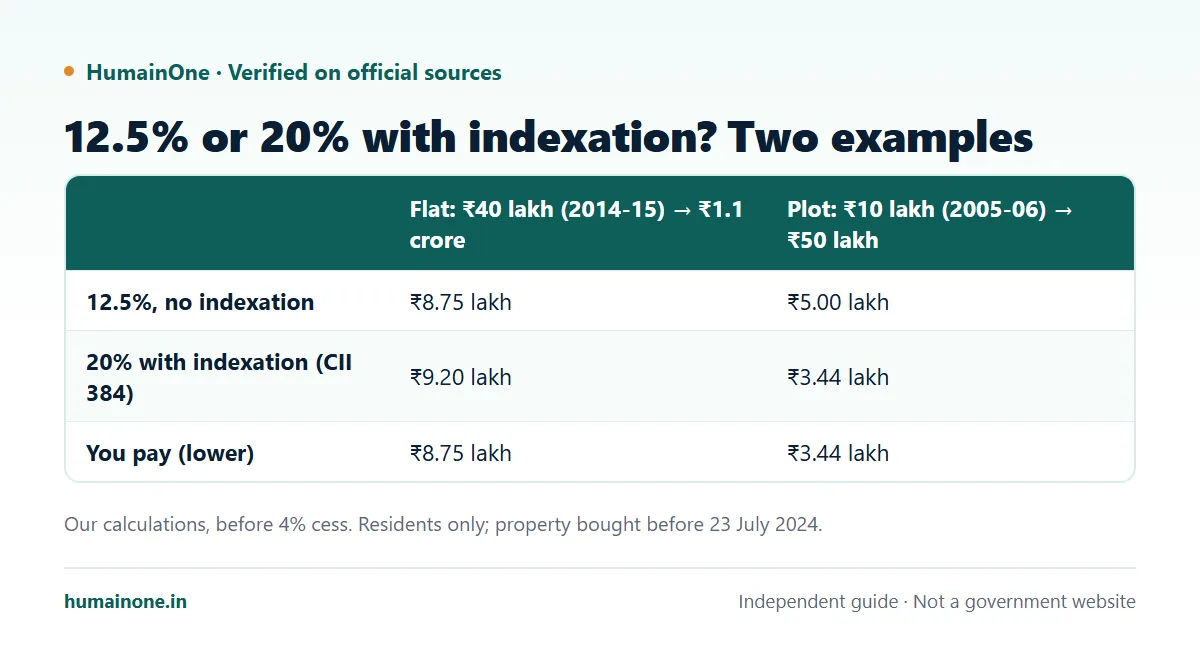
Sunil Kulkarni, 58, bought a 1BHK flat in Pune in 2014-15 for ₹40 lakh. He is selling it in October 2026 for ₹1.1 crore to help his son buy a bigger home. His neighbour Meena is selling a plot her father bought in 2005-06 for ₹10 lakh for ₹50 lakh. Both have held for well over 24 months, so both have long-term gains — but the cheaper tax option is different for each of them.
Step 1 — Short-term or long-term?
| You held the property for | Type of gain | Tax |
|---|---|---|
| 24 months or less | Short-term capital gain (STCG) | Added to your income, taxed at your slab rate |
| More than 24 months | Long-term capital gain (LTCG) | 12.5% without indexation (+ 4% cess, surcharge if applicable) |
Step 2 — Work out the gain both ways (if bought before 23 July 2024)
Gain = Sale price − (purchase cost + cost of improvement + expenses on sale such as brokerage).
With indexation, the purchase cost is increased for inflation: Indexed cost = Cost × (CII of year of sale ÷ CII of year of purchase). For a sale in 2026-27, use 384.
Resident individuals and HUFs pay whichever tax is lower. Here are our calculations (before cess):
| Sunil (flat) | Meena (plot) | |
|---|---|---|
| Bought | 2014-15, ₹40 lakh (CII 240) | 2005-06, ₹10 lakh (CII 117) |
| Sold | 2026-27, ₹1.10 crore (CII 384) | 2026-27, ₹50 lakh (CII 384) |
| Option A: 12.5%, no indexation | Gain ₹70 lakh → tax ₹8.75 lakh | Gain ₹40 lakh → tax ₹5.00 lakh |
| Option B: 20% with indexation | Indexed cost ₹64 lakh → gain ₹46 lakh → tax ₹9.20 lakh | Indexed cost ₹32.82 lakh → gain ₹17.18 lakh → tax ₹3.44 lakh |
| Tax payable (lower) | ₹8.75 lakh (12.5% wins) | ₹3.44 lakh (indexation wins) |
Rule of thumb: for property bought long ago (when the CII was low), 20% with indexation often wins. For property bought in the last 10–12 years with big price growth, 12.5% often wins. Always calculate both. Non-residents and property bought on or after 23 July 2024 get only the 12.5% option.
Step 3 — Save the tax legally
| Option | New section (old) | What you must do | Limit |
|---|---|---|---|
| Buy or build another house | 82 (old 54) — for gain on a residential house | Buy 1 year before or 2 years after the sale, or build within 3 years | Exemption up to the gain; cost above ₹10 crore ignored. If gain is ≤ ₹2 crore, you may buy two houses (once) |
| Specified bonds | 85 (old 54EC) — for gain on land or building | Invest within 6 months of the sale in long-term specified bonds (NHAI, REC and other notified issuers) | ₹50 lakh maximum; 5-year lock-in |
| Sold another asset (plot, gold, shares) | 86 (old 54F) | Invest the net sale price in one house in the same time limits | Proportional exemption; not if you already own more than one other house; ₹10 crore cap |
Not ready to buy before filing your return? Deposit the unused amount in the Capital Gains Account Scheme at a bank before the return due date and attach proof — then use it within the time limit. If you sell the new house within 3 years, the exemption is taken back.
So Sunil can avoid most of his ₹8.75 lakh tax by helping buy the new home in his own name within 2 years (section 82), or by putting up to ₹50 lakh in bonds within 6 months (section 85) and paying tax only on the rest.
Step 4 — TDS, advance tax and the return
- The buyer deducts 1% TDS if the price (or stamp duty value, whichever is higher) is ₹50 lakh or more — check it in your Form 26AS / AIS. See TDS not showing in 26AS.
- The 1% TDS is usually much less than your actual tax. Pay the balance as advance tax in the quarter of the sale to avoid interest — see advance tax.
- Report the sale in the capital gains schedule of your income-tax return.
- Section numbers changed from 1 April 2026 under the new Act — see old vs new section numbers.
Frequently asked questions
What is the capital gains tax on selling property in 2026?
If held for more than 24 months, 12.5% without indexation. Resident individuals and HUFs selling land or a building bought before 23 July 2024 can instead pay 20% with indexation if that is lower. If held for 24 months or less, the gain is taxed at your slab rate.
What is the Cost Inflation Index for 2026-27?
384, notified by CBDT in Notification No. 85/2026 dated 15 July 2026. For 2025-26 it was 376.
Is indexation still allowed on property?
Only for resident individuals and HUFs on land or buildings acquired before 23 July 2024, as an option: you pay the lower of 12.5% without indexation or 20% with indexation.
How can I save capital gains tax on a flat sale?
Buy or build another residential house within the time limits (section 82, old 54), invest up to ₹50 lakh within 6 months in specified bonds (section 85, old 54EC), or deposit the amount in the Capital Gains Account Scheme before the return due date.
What is section 54 called in the new Income-tax Act?
The exemption for reinvesting gain from a residential house in another house is section 82 of the Income-tax Act, 2025. The bond option (old 54EC) is section 85 and the old 54F is section 86.
Does the buyer have to deduct TDS on property?
Yes, 1% of the price or stamp duty value, whichever is higher, when it is ₹50 lakh or more.
Official links
Use only these government websites. HumainOne is not connected to any of them.
- Income-tax Act, 2025 — Section 197 (rates on LTCG)12.5% and the 20% indexation option
- CBDT Notification 85/2026 — Cost Inflation IndexCII 384 for 2026-27
- Income Tax Department — Tax on long-term capital gainsHolding period, CII table, examples
- Income-tax Act, 2025 — Sections 82, 85, 86Exemptions on reinvestment
Disclaimer: HumainOne is an independent information website. We are not affiliated with UIDAI, the Income Tax Department, EPFO, NPCI, the Election Commission, the Government of Maharashtra or any government body. We do not accept applications, documents or fees. Information is checked against official sources on the date shown but rules change — always confirm on the official website before acting. Calculators give estimates, not official figures, and this is not tax or legal advice.