Section 87A rebate, now section 156: zero tax up to ₹12 lakh in the new regime, ₹5 lakh in the old, and how marginal relief works
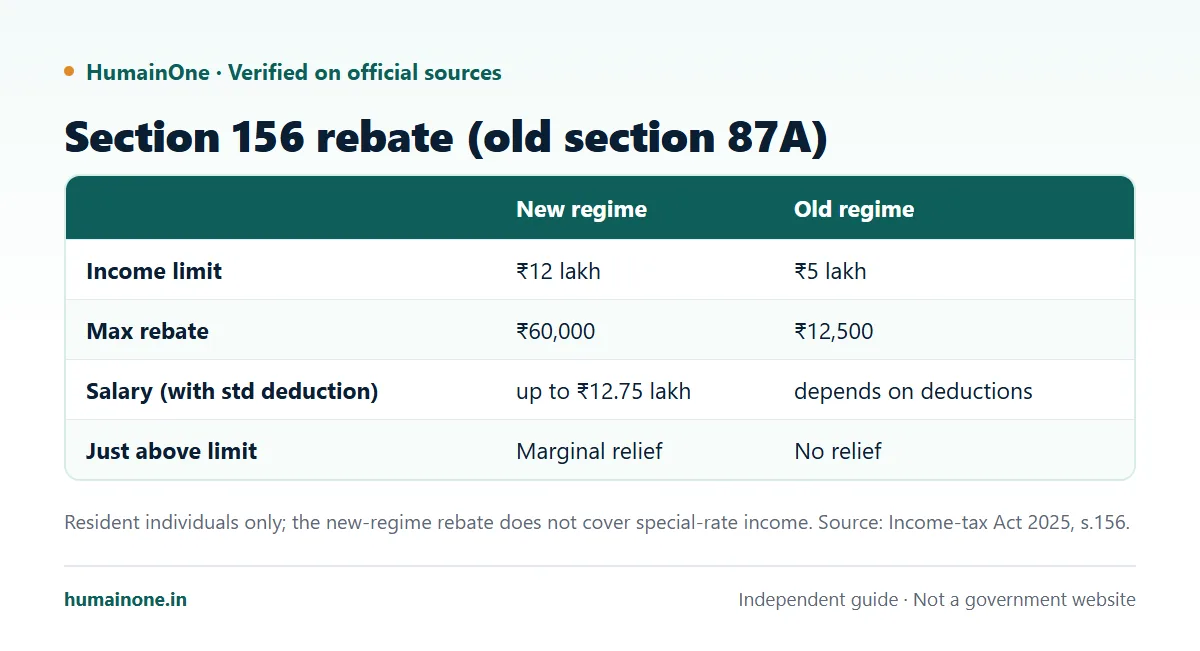
The rebate that was section 87A is now section 156 of the Income-tax Act, 2025 (from Tax Year 2026-27). A resident individual gets: (1) new regime — if total income is up to ₹12 lakh, a rebate of 100% of tax or ₹60,000, whichever is less, so tax is nil; just above ₹12 lakh, marginal relief keeps your tax no more than the income above ₹12 lakh; (2) old regime — if total income is up to ₹5 lakh, a rebate of 100% of tax or ₹12,500. Salaried people in the new regime also get the ₹75,000 standard deduction, so salary up to ₹12.75 lakh pays no tax. The new-regime rebate applies only to tax at the normal slab rates — it doesn't cover special-rate income such as capital gains taxed at special rates. NRIs, HUFs and firms don't get it.
Key facts Last verified: 16 Nov 2026
| Item | Details | Source |
|---|---|---|
| Old regime rebate | Resident individual, total income ≤ ₹5,00,000: 100% of tax or ₹12,500, whichever is less | Income-tax Act 2025, section 156(1) |
| New regime rebate | Income taxed under section 202(1), income ≤ ₹12 lakh: 100% of tax or ₹60,000, whichever is less | Income-tax Act 2025, section 156(2)(a) |
| Marginal relief | Income above ₹12 lakh: rebate = tax minus (income − ₹12 lakh), when tax is more than the excess income | Income-tax Act 2025, section 156(2)(b) |
| Limit | New-regime rebate can't exceed tax at the section 202(1) rates | Income-tax Act 2025, section 156(3) |
| Who | Individuals resident in India only | Income-tax Act 2025, section 156 |
| Old number | Section 87A of the Income-tax Act, 1961 | Income Tax Department |
Anita earns ₹11.8 lakh a year from her job in Nashik (after the standard deduction, her taxable income is ₹11.05 lakh). Her colleague said "you're above ₹10 lakh, you'll pay ₹70,000 tax". Under the new regime, her slab tax would be ₹50,500 — and the rebate wipes it out. Her tax is zero. Here is how the rebate works, with the new section number you'll see on Form 130 and the ITR.
Section 87A is now section 156
The Income-tax Act, 2025 replaced the 1961 Act from 1 April 2026 (Tax Year 2026-27). The rebate moved from section 87A to section 156, with the same amounts. For income of FY 2025-26 (the return filed in 2026), the old Act's section 87A still applies — and the amounts are the same. See old vs new section numbers.
How much rebate do you get?
| New regime (default) | Old regime | |
|---|---|---|
| Income limit | Total income up to ₹12,00,000 | Total income up to ₹5,00,000 |
| Maximum rebate | ₹60,000 | ₹12,500 |
| Result | Nil tax up to ₹12 lakh | Nil tax up to ₹5 lakh |
| Salaried (with standard deduction) | Salary up to ₹12,75,000 (₹75,000 deduction) | Depends on deductions claimed |
| Above the limit | Marginal relief (see below) | No relief — full tax |
"Total income" means income after deductions (standard deduction, and in the old regime 80C-type deductions), not your gross salary.
Marginal relief just above ₹12 lakh
Without relief, earning ₹1 more than ₹12 lakh would suddenly cost you ₹60,000+ in tax. Section 156(2)(b) fixes this: if your income is a little above ₹12 lakh, your tax can't be more than the amount by which your income exceeds ₹12 lakh.
| Total income (new regime) | Slab tax | Income above ₹12 lakh | Tax you pay |
|---|---|---|---|
| ₹12,00,000 | ₹60,000 | — | ₹0 (full rebate) |
| ₹12,10,000 | ₹61,500 | ₹10,000 | ₹10,000 |
| ₹12,50,000 | ₹67,500 | ₹50,000 | ₹50,000 |
| ₹12,75,000 | ₹71,250 | ₹75,000 | ₹71,250 (relief no longer helps) |
Relief stops at roughly ₹12.70 lakh of total income, where slab tax becomes lower than the excess. Health and education cess (4%) is added on the tax you pay. Try your numbers in the income tax calculator.
What the rebate does NOT cover
Special-rate income. Section 156(3) says the new-regime rebate can't exceed the tax at the normal slab rates of section 202(1). Income taxed at special rates — for example capital gains taxed at special rates (equity gains, property gains), or lottery and online-game winnings — stays taxable even if your total income is below ₹12 lakh. Check the details for your case in the ITR utility.
- Non-residents (NRIs) — rebate is only for individuals resident in India.
- HUFs, firms, companies — individuals only.
- Surcharge doesn't arise below ₹50 lakh, so it isn't relevant here.
Claiming it
You don't apply for the rebate separately:
- Employer TDS: your employer gives the rebate while deducting TDS, so tax may be zero on your payslip — check Form 130 (formerly Form 16). See Form 130.
- ITR: the e-filing utility applies it automatically when your income qualifies. You still file the return if your income is above the basic exemption limit (₹4 lakh new regime) or you want a refund.
Frequently asked questions
What is section 87A rebate for FY 2026-27?
From Tax Year 2026-27 it is section 156 of the Income-tax Act, 2025. In the new regime, resident individuals with total income up to ₹12 lakh get a rebate of up to ₹60,000, so tax is nil. In the old regime, the limit is ₹5 lakh and the rebate is up to ₹12,500.
Is salary up to ₹12.75 lakh tax-free?
In the new regime, yes: the ₹75,000 standard deduction brings taxable income to ₹12 lakh, which is fully covered by the rebate.
What happens if my income is slightly above ₹12 lakh?
Marginal relief under section 156(2)(b) applies: your tax can't be more than your income above ₹12 lakh. It stops helping at around ₹12.70 lakh.
Can I claim the rebate on short-term capital gains?
The new-regime rebate is limited to tax at the normal slab rates. Income taxed at special rates, like many capital gains, is not covered.
Can an NRI claim section 87A or 156 rebate?
No. The rebate is available only to individuals resident in India.
Official links
Use only these government websites. HumainOne is not connected to any of them.
- Income-tax Act, 2025 — Section 156Rebate of income-tax in case of certain individuals
- Income Tax DepartmentActs, rules and FAQs
- e-Filing portalITR filing
Disclaimer: HumainOne is an independent information website. We are not affiliated with UIDAI, the Income Tax Department, EPFO, NPCI, the Election Commission, the Government of Maharashtra or any government body. We do not accept applications, documents or fees. Information is checked against official sources on the date shown but rules change — always confirm on the official website before acting. Calculators give estimates, not official figures, and this is not tax or legal advice.